

By Sylvain Delcomminette
ISBN-10: 9004150269
ISBN-13: 9789004150263
This publication offers with the character and serve as of the nice in Plato’s philosophy, through targeting the discussion explicitly dedicated to it: the Philebus. It presents a complete remark of this tough discussion within which just about all the subjects of Plato’s philosophy are mentioned or alluded to. the writer indicates scrupulous research and reconstruction of its argumentative development makes it attainable to find the harmony among those diverse themes, and argues that this team spirit lies within the proven fact that Plato develops there what he was once calling for significantly within the Republic, i.e. a (dialectical) technology of the great (or ‘agathology’). learn from this perspective, the Philebus appears to be like as a discussion of large significance for the certainty of Plato’s philosophy as an entire.
Read Online or Download Le Philèbe de Platon: Introduction à l'agathologie platonicienne PDF
Similar philosophy books

Simon O'Sullivan's Art Encounters Deleuze and Guattari: Thought beyond PDF
In a chain of philosophical discussions and creative case reports, this quantity develops a materialist and immanent method of sleek and modern paintings. The argument is made for a go back to aesthetics--an aesthetics of effect--and for the theorization of paintings as an increased and intricate perform. Staging a sequence of encounters among particular Deleuzian options; the digital, the minor, the fold, and so forth.
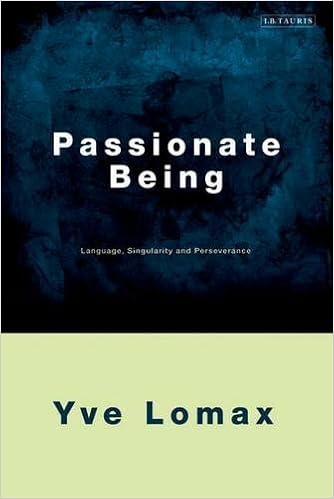
Download e-book for kindle: Passionate Being: Language, Singularity and Perseverance by Yve Lomax
Written via either the 1st and moment individual singular, 'Passionate Being' takes its writer and its reader on a trip that has them contemplating their adventure of and belonging to language and the potential of an example of the area taking-place with no prejudice and exclusion.
At its starting, it brings to its writer the query ‘What are you able to say? ’ The responses that happen flip our realization towards presupposition and approximately how ‘singularity’ might be stated. The e-book additionally brings into play, between others, the paintings of Giorgio Agamben. It asks us to view either language and the realm taking-place with out presupposition, revealing either the political implications, and people for residing, that this imaginative and prescient holds. it's a paintings to be learn two times with excitement, after which again.
'Here Yve Lomax, some of the most unique and important artists and writers operating this day, proves back why her paintings has been crucial to the institution of the self-discipline of artwork Writing.
'Passionate Being' is either end result of and departure from earlier paintings. It takes the "art of writing" to a brand new size and is essential examining for all those that search an immersive adventure with language and the realm. ' - Anne Tallentire, Professor of good paintings, important St Martins university of paintings and Design
Review
""Passionate Being takes the 'art of writing' to a brand new size and is essential studying for all those that search an immersive adventure with language and the realm. ’"" -- Anne Tallentire, Professor of excellent artwork, important St Martins collage of paintings and Design
About the Author
Yve Lomax is Professor in paintings Writing at Goldsmiths university and examine educate for wonderful Art/Photography on the Royal collage of paintings. Yve Lomax's books Writing the picture: An event with artwork and thought and Sounding the development: Escapades in discussion & issues of paintings, Nature & Time have been released by way of I. B. Tauris in respectively 2000 and 2004.


- The Demiurge in Ancient Thought: Secondary Gods and Divine Mediators
- Go Slow and Curvy: Understanding the Philosophy of the Cittaslow slowcity Phenomenon
- Between Leibniz, Newton, and Kant: Philosophy and Science in the Eighteenth Century
- Deviens qui tu es : La philosophie grecque à l'épreuve du quotidien
Additional info for Le Philèbe de Platon: Introduction à l'agathologie platonicienne
Example text
Les textes cités ci-dessus dans la note 37. 41 Voir en particulier, et en des sens très différents, Raeder (1905), p. 356 ; Dixsaut (1985), pp. 181–182 ; Natorp (1994), pp. 348–349. 42 Cf. Migliori (1993), notamment pp. 486–499. introduction 15 rigoureux et continu qui permet de comprendre la logique du passage de l’une à l’autre. Cette logique, nulle source externe ne pourra jamais l’expliquer : elle réside dans le cheminement interne du dialogue, qu’il s’agit dès lors de reconstruire par et pour lui-même.
Mais cela ne veut pas dire que la recherche manque son but, car ce type d’hédonisme est le seul qui soit susceptible d’être réfuté33. 30 On comprendra dès lors que nous résistions à toute tentative d’assimiler Philèbe à un personnage historique quelconque : non seulement parce que sa position est également celle de la multitude des hommes et des animaux (cf. 66 e2–3, 67 b1–7), mais aussi et surtout parce qu’il s’agit avant tout d’un personnage dramatique dont le comportement ne prend sens que dans le contexte du dialogue.
171, d’autant moins que la distinction entre ces deux approches et leurs implications est déjà faite relativement à la vertu en Ménon, 73 e1–8. Sur cette différence, voir également Aristote, Premiers analytiques, I, 40, 49 b10–13. 22 Cette position est explicitement énoncée à la fin du dialogue, où elle est attribuée à Philèbe : Φ ληβ ς φησι τ ν δον ν σκοπ ν ρ ν π σι ζ οις γεγον ναι κα δε ν π ντας το του στοχ ζεσ αι, κα δ κα τ γα ν το τ α τ ε ναι σ μπασι, κα δ ο ν ματα, γα ν κα δ , ν τινι κα φ σει μι το τω ρ ς τε ντ χειν (60 a7–b1).
Le Philèbe de Platon: Introduction à l'agathologie platonicienne by Sylvain Delcomminette
by Richard
4.3