
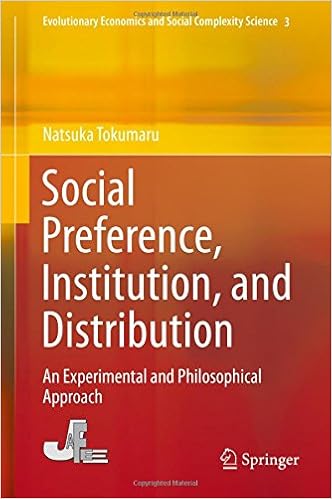
By Natsuka Tokumaru
ISBN-10: 9811001375
ISBN-13: 9789811001376
This is often the 1st booklet to check behavioral theories on social choice from institutional and philosophical views utilizing monetary experiments. The experimental procedure in economics has challenged imperative behavioral assumptions according to rationality and selfishness, offering empirical proof that not just revenue looking but in addition social personal tastes topic in individuals’ choice making. by means of appearing distribution experiments in institutional contexts, the writer extends assumptions approximately human habit to appreciate real social economic climate. The e-book additionally goals to complement behavioral theories of economics directed towards institutional evolution.The writer scrutinizes how particular institutional stipulations increase or mute individuals’ egocentric incentives or their equity beliefs resembling egalitarian, performance-based, labor-value radicalism or libertarianism. From experimental effects and their research, implications for real difficulties in social economic system and institutional swap are derived: why performance-based pay usually fails to advertise workers’ productiveness; why hard work wages decline while shareholder’s values bring up after financialization; and no matter if socially accountable funding could be a social establishment for company governance.The publication can also be addressed to philosophers of social sciences attracted to how experimental tools can give a contribution to constructing cognition of human behaviors and be prolonged to social theories. concerning behavioral theorists within the background of monetary notion, the writer discusses the meanings of experiments within the method of social sciences. She additionally proposes new methods of reading experimental effects by way of reviving historical social theories and utilizing them to genuine social difficulties.
Read or Download Social Preference, Institution, and Distribution: An Experimental and Philosophical Approach (Evolutionary Economics and Social Complexity Science, Volume 3) PDF
Similar economics books

Economics and Utopia: Why the Learning Economy is Not the - download pdf or read online
Because the fall of the Berlin Wall we now have been instructed that no substitute to Western capitalism is feasible or fascinating. This booklet demanding situations this view with arguments. First, the above premise ignores the big sort inside of capitalism itself. moment, there are huge, immense forces of transformation inside of modern capitalisms, linked to strikes in the direction of a extra knowledge-intensive economic system.

Download e-book for kindle: America Alone: The End of the World As We Know It by Mark Steyn
It's the tip of the realm as we all know it. ..
Someday quickly, it's possible you'll get up to the decision to prayer from a muezzin. Europeans already are. And liberals will nonetheless let you know that "diversity is our strength"--while Talibanic enforcers cruise Greenwich Village burning books and barber outlets, the ultimate court docket comes to a decision sharia legislations doesn't violate the "separation of church and state," and the Hollywood Left comes to a decision to renounce on homosexual rights in prefer of the a lot more secure charms of polygamy. if you happen to imagine this can't ensue, you haven't been being attentive, because the hilarious, provocative, and magnificent Mark Steyn--the most well liked conservative columnist within the English-speaking world--shows to devastating impact. the longer term, as Steyn indicates, belongs to the fecund and the convinced. And the Islamists are either, whereas the West is calling ever extra just like the ruins of a civilization. yet the US can continue to exist, prosper, and shield its freedom provided that it maintains to think in itself, within the sturdier virtues of self-reliance (not government), within the centrality of kin, and within the conviction that our state relatively is the world's final top wish. Mark Steyn's the United States on my own is laugh-out-loud funny--but it is going to additionally swap how you examine the area.

Get Knowledge: Its Creation, Distribution and Economic PDF
With this primary of 8 volumes, the eminent economist Fritz Machlup launches his enormous inquiry into the construction of data as an fiscal job. quantity I provides the conceptual framework for this inquiry and falls into 3 elements: kinds of wisdom, characteristics of data, and information as a Product.

The Economics of Informational Decentralization: Complexity, - download pdf or read online
During this quantity are papers written through scholars and co-authors of Stanley Reiter. the gathering displays to a point the variety of his pursuits and highbrow interest. He has released papers in statistics, deal with ment technological know-how, overseas alternate, and welfare economics. He co-authored early papers in monetary historical past and is stated to be principally accountable for giving the sphere its identify of Cliometrics.
- John Stuart Mill: Principles of Political Economy With Some of Their Applications to Social Philosophy
- The Creature from Jekyll Island: A Second Look at the Federal Reserve
- Institutions and European Trade: Merchant Guilds, 1000-1800
- The Great Risk Shift: The New Economic Insecurity and the Decline of the American Dream
- Keynes and India: A Study in Economics and Biography
Extra resources for Social Preference, Institution, and Distribution: An Experimental and Philosophical Approach (Evolutionary Economics and Social Complexity Science, Volume 3)
Example text
290). The approach adopts a version of expected utility theory with human welfare usually translating into private market consumption per head in the applied models. The theory is applied to utility across countries with huge differences in consumption and to utility gained many years into the future, when consumption can rise perhaps many times over. This traditional approach to economics has largely ignored other disciplines tackling the same problems of justifying assumptions and understanding human behaviour.
An interesting distinction in this context and on the policy score is made by Blinder (2010). It is suggested that there are two types of bubbles. Those associated with relatively little debt finance, where the typical example is ‘equity-like bubbles’. Under this type of bubble the recommended policy is to react after the bubble has burst. The second type is the debt-financed bubbles, where early intervention to contain the bubble is proposed. In this context ‘supervisory weapons’ are recommended rather than monetary policy.
This may be a principle rather than a numerical value, recognising the difficulties of determining whether a principle held in practice. Let us suppose for a few minutes that some rules could be enunciated on the size of current account deficits (and that may also require some corresponding rules on current account surpluses). The question then is whether there is any way in which such rules could be implemented. The Stability and Growth Pact drew up rules on budget deficits; why should there not be corresponding rules in relation to current account deficits?
Social Preference, Institution, and Distribution: An Experimental and Philosophical Approach (Evolutionary Economics and Social Complexity Science, Volume 3) by Natsuka Tokumaru
by Anthony
4.1