
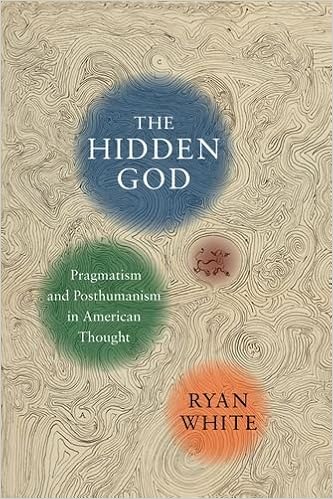
By Ryan White
ISBN-10: 0231539592
ISBN-13: 9780231539593
The Hidden God revisits the origins of yank pragmatism and reveals a nascent "posthumanist" critique shaping early glossy inspiration. via achieving way back to the Calvinist arguments of the yank Puritans and their fight to understand a "hidden God," this publication extends the parameters of highbrow historical past to deliver American pragmatism in the direction of modern severe theory.
The learn reads the writings of key American philosophers, together with Jonathan Edwards, Ralph Waldo Emerson, William James, and Charles Sanders Peirce, opposed to smooth theoretical works by means of Niklas Luhmann, Richard Rorty, Jacques Derrida, Sharon Cameron, Cary Wolfe, and Gregory Bateson. This juxtaposition isolates the notably posthumanist type of pragmatism that started to come up in those early texts, not easy the accredited family tree of pragmatic discourse and customary definitions of posthumanist critique. Its conscientiously theoretical standpoint has vast implications for arts study, enriching investigations into literature, historical past, politics, and art.
Source: Amazon.com Retail MOBI (via library)
Read or Download The Hidden God: Pragmatism and Posthumanism in American Thought PDF
Similar philosophy books

Download e-book for iPad: Art Encounters Deleuze and Guattari: Thought beyond by Simon O'Sullivan
In a sequence of philosophical discussions and inventive case stories, this quantity develops a materialist and immanent method of smooth and modern paintings. The argument is made for a go back to aesthetics--an aesthetics of effect--and for the theorization of paintings as an increased and complicated perform. Staging a sequence of encounters among particular Deleuzian recommendations; the digital, the minor, the fold, and so forth.
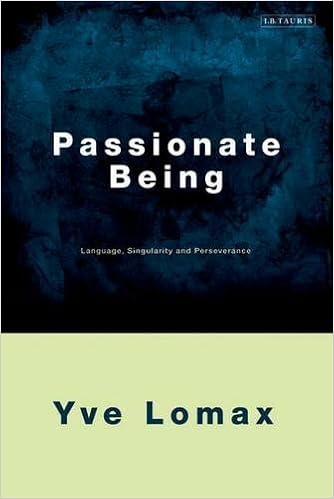
Passionate Being: Language, Singularity and Perseverance - download pdf or read online
Written via either the 1st and moment individual singular, 'Passionate Being' takes its writer and its reader on a trip that has them contemplating their event of and belonging to language and the potential for an example of the area taking-place with out prejudice and exclusion.
At its starting, it brings to its writer the query ‘What are you able to say? ’ The responses that happen flip our recognition towards presupposition and approximately how ‘singularity’ may be acknowledged. The e-book additionally brings into play, between others, the paintings of Giorgio Agamben. It asks us to view either language and the area taking-place with out presupposition, revealing either the political implications, and people for dwelling, that this imaginative and prescient holds. it's a paintings to be learn two times with excitement, after which again.
'Here Yve Lomax, some of the most unique and important artists and writers operating this present day, proves back why her paintings has been vital to the institution of the self-discipline of artwork Writing.
'Passionate Being' is either fruits of and departure from earlier paintings. It takes the "art of writing" to a brand new size and is important analyzing for all those that search an immersive adventure with language and the realm. ' - Anne Tallentire, Professor of excellent paintings, valuable St Martins collage of artwork and Design
Review
""Passionate Being takes the 'art of writing' to a brand new size and is important analyzing for all those that search an immersive event with language and the realm. ’"" -- Anne Tallentire, Professor of excellent artwork, important St Martins collage of artwork and Design
About the Author
Yve Lomax is Professor in artwork Writing at Goldsmiths collage and study educate for superb Art/Photography on the Royal collage of paintings. Yve Lomax's books Writing the picture: An experience with paintings and concept and Sounding the development: Escapades in discussion & concerns of paintings, Nature & Time have been released by way of I. B. Tauris in respectively 2000 and 2004.


- Scientific Sources and Teaching Contexts Throughout History: Problems and Perspectives
- The Cambridge Companion to German Idealism (Cambridge Companions to Philosophy)
- Receptive Spirit: German Idealism and the Dynamics of Cultural Transmission
- Shifting Shape, Shaping Text: Philosophy and Folklore in Fox Koan
- Die Milesier, Band 1: Thales (Traditio Praesocratica, Band 1)
Additional info for The Hidden God: Pragmatism and Posthumanism in American Thought
Sample text
Now, we are told, we have to investigate how the concept of essence applies to separated substances: namely, the soul, the intelligences, and the first cause. Aquinas assumes that his readers know what these are. By ‘the soul’ he means the souls of human beings, in the intermediate state between death and the final resurrection to which he and all Christians looked forward. During this period, it was believed, human souls existed disembodied. By ‘the intelligences’ he means both the angels of biblical tradition and the On Being and Essence: II immaterial agencies that in Aristotelian theory were responsible for the movements of the heavens.
Some philosophers have said that God has no essence: this is correct if all it means is that he does not have an essence that is distinct from his esse. 147–54). 28 See below, p. 116. 29 Everything there is has esse; in saying this we make use of a universal concept of esse. But in saying that God is pure esse we do not mean that he is this universal. For the universal concept neither includes or excludes the addition of other characteristics: for instance, if, like Descartes, I say that I am, this neither affirms nor denies that I am an animal with a body.
A thing’s esse cannot be an effect of its nature, because that would mean that the thing was its own cause. So anything whose esse is not identical with its nature derives its esse from something else. 23 Accordingly, Aquinas concludes that the intelligences, which are composed of form and esse, derive their esse from a primary being which is pure esse, and this is the first cause, which is God. Throughout this argument, as in the phoenix argument discussed earlier, esse has to be taken as existence.
The Hidden God: Pragmatism and Posthumanism in American Thought by Ryan White
by Robert
4.0