
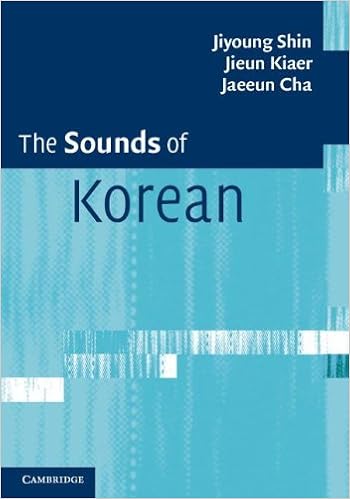
By Professor Jiyoung Shin, Dr Jieun Kiaer, Professor Jaeeun Cha
ISBN-10: 1107672686
ISBN-13: 9781107672680
This creation to the sounds of Korean is designed for English-speaking scholars with out earlier wisdom of the language and contains on-line sound documents, which show the sounds and pronunciation defined. it is going to be a useful source for college students of Korean desirous to comprehend the foundation of the present nation of Korean phonetics and phonology, in addition to for these learning Korean linguistics. • presents an entire and authoritative description and rationalization of the present nation of Korean phonetics and phonology • provides transparent comparisons with English and gives useful suggestion on pronunciation • offers a wealth of actual Korean examples. • every one bankruptcy includes routines and were you aware? sections to aid scholars placed their wisdom into perform.
Read Online or Download The Sounds of Korean PDF
Best instruction books
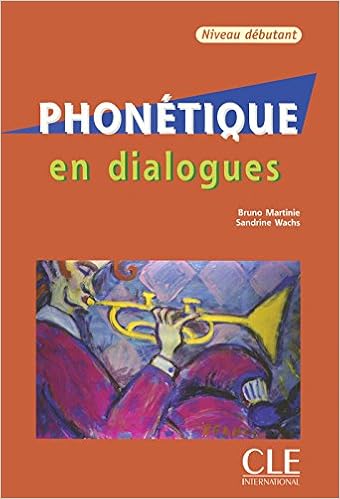
Martinie's Phonetique En Dialogues: Niveau Debutan PDF
L. a. phonétique en dialogues s'adresse à des adultes et grands young people de niveau débutant. L'ouvrage permet d'aborder les caractéristiques articulatoires et prosodiques majeures du français ainsi que les problèmes attenants tels que los angeles liaison ou le rapport phonie/graphie illustré par des tableaux très complets en fin de quantity.

In line with the 1903 version, this appealing, newly typeset reprint of the vintage paintings in Latin Grammar has a few updating of the fabric on meter. the main procedure universal to reference grammar in different Latin texts has been retained. to be had additionally in hardcover.
New PDF release: Etymological Vocabulary of the Shughni Group
Shughni is crucial member of a bunch of jap Iranian dialects spoken within the Pamirs, now quite renowned, principally due to the paintings of Soviet students. This staff has retained a good number of old Iranian phrases, and the dialect edition of phonetical improvement permits us in lots of instances to reconstruct extra archaic types than the current ones.
- A Reader on the Sanskrit Grammarians
- Der gestiefelte Kater
- Teach Yourself Hungarian Complete Course.
- Oxford English-Greek Learner's Dictionary
Additional resources for The Sounds of Korean
Sample text
21) Old man (in the neighbourhood): ⲏ㠞┞? ’ Boy : 㞚, 㞞 ⲏ㠞㠊㣪. ’ (22) Boy : ⲏ㠞┞? ’ Old man (in the neighbourhood): ??? There are three kinds of honorification in Korean: subject, hearer and object honorification. Subject honorification is realised by the use of the pre-final ending -㔲- as in (23). 3 Map of Korean dialects (23) Subject honorification ㏦┮✺-㧊 㰧-㠦 Ṗ-㔲-㠞-┺. ’ Hearer honorification is now the most commonly used and is realised by different endings. (24a) shows high respect of the speaker towards the hearer, while (24b) reveals the hearer being lower than the speaker.
In fact, these two phonation types are not effective methods of phonation. To begin with, the tone is quiet, and you need to breathe more often than normal in order to continue speaking in this way. Of course, these sounds are inevitably quieter than normal voiced sounds, as the vocal folds are vibrating only partially (breathy sounds) or are not vibrating at all (voiceless sounds). Furthermore, as the vocal folds are entirely or partially open, more air will escape compared to when you produce normal voiced sounds, and it will thus be harder to speak for longer using one breath.
Sounds that are tense tend to be strong sounds with lengthy articulation. With aspiration and tense as class features, we are now able to distinguish between the types of stops and affricates in the Korean language. (7) shows bilabial stops categorised according to the three phonation types of stops and affricates. (7) Korean bilabial stops with(out) tension p (ථ) p* (ද) (voiceless unaspirated (voiceless unaspirated lenis) fortis) ph (ඹ) (voiceless aspirated fortis) In Korean, the voiceless unaspirated lenis is referred to as lax, the voiceless unaspirated fortis as tense, and the voiceless aspirated fortis as aspirated.
The Sounds of Korean by Professor Jiyoung Shin, Dr Jieun Kiaer, Professor Jaeeun Cha
by Daniel
4.2