
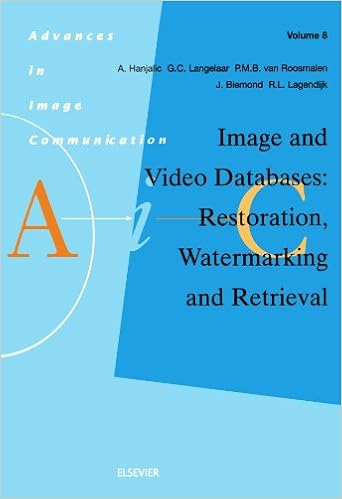
By A. Hanjalic
ISBN-10: 0444505024
ISBN-13: 9780444505026
This booklet presents an in-depth therapy of the 3 vital issues regarding picture and video databases: recovery, watermarking and retrieval. it's the results of the participation of the Delft college of know-how within the eu Union ACTS application, a pre-competitive R&D application on complicated Communications applied sciences and providers (1994-1998). particularly the booklet has benefited from participation within the AURORA and destroy tasks respectively automatic movie and video recovery and garage for multimedia platforms (watermarking & retrieval).
Read Online or Download Image and video databases: restoration, watermarking, and retrieval PDF
Similar video books

New PDF release: Time (25 May 2015)
Time, could 25 2015
Download e-book for kindle: TIME (19 October 2015) by
TIME magazine’s signature voice and depended on content material make it the most famous information manufacturers on the planet. delivering incisive reporting, energetic writing and world-renowned images, TIME has been credited with bringing journalism at its top into the material of yank lifestyles. each factor provides a deeper realizing of the area we are living in.
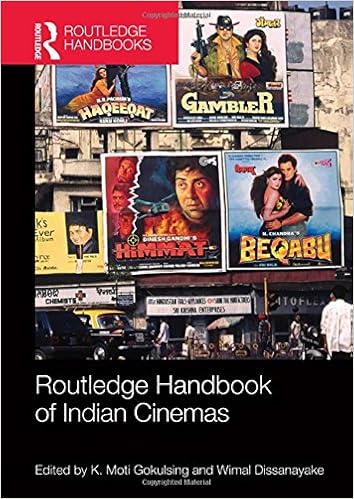
Download PDF by K. Moti Gokulsing, Wimal Dissanayake: Routledge Handbook of Indian Cinemas
India is the most important movie generating kingdom on the earth and its output has a world achieve. After years of marginalisation via lecturers within the Western international, Indian cinemas have moved from the outer edge to the centre of the area cinema in a relatively brief house of time. Bringing jointly contributions from major students within the box, this instruction manual seems to be on the complicated purposes for this awesome trip.

The coming of the electronic age has created the necessity to manage to shop, deal with, and digitally use an ever-increasing volume of video and audio fabric. hence, video cataloguing has emerged as a demand of the days. Video Cataloguing: constitution Parsing and content material Extraction explains how one can successfully practice video constitution research in addition to extract the elemental semantic contents for video summarization, that is crucial for dealing with large-scale video facts.
- Women, Desire, and Power in Italian Cinema
- Bakhtin and the Movies: New Ways of Understanding Hollywood Film
- Fade to Black: A Book of Movie Obituaries
- Game of Colors: Moderne Bewegtbildproduktion: Theorie und Praxis für Film, Video und Fernsehen
- Video und Super-8 in Jugendgruppen: Eine Anleitung zu Produktion und Einsatz
- Standard Handbook of Video and Television Engineering 4th Edition
Extra resources for Image and video databases: restoration, watermarking, and retrieval
Example text
There are many solutions to a restoration problem that give identical observed signals when the degradation model (though be it with different parameters) is applied to them. For example, image data corrupted by blotches can be restored by a number of methods (Chapter 4), each of which gives a different solution. However, none of the solutions conflict with the degradation process and with the observed data that result from the degradation process. The restoration problem is ill posed in the sense that no unique inverse to the degradation exists.
Many motion estimators, including the hierarchical motion estimator used in this book, assume the constant luminance constraint [Tek95]. This constraint, which requires that there be no variations in luminance between consecutive frames, is not met in the presence of intensity flicker. 6d shows the MSE computed for the three test sequences to which varying amounts of intensity flicker have been added. 6a-c. In conclusion, artifacts can have a considerable impact on the accuracy of estimated motion vectors.
Because these estimates will never be perfect, the effects of errors in a ( i ) and b(i) on y(t) is investigated. To simplify the analysis, the influence of noise is discarded. For ease of notation, the following analysis leaves out the spatial and temporal indices. Let a = a + Da and b - b + Db. 1 plots the reconstruction error as a function of Da and Db with a = 1, b = 0 and y=100. 7) shows that Ay is much more sensitive to errors in a ( i ) than to errors in b ( i ) . It also shows that the sensitivity due to errors Act can be minimized in absolute terms by centering the range of image intensities around 0.
Image and video databases: restoration, watermarking, and retrieval by A. Hanjalic
by George
4.5