
By Rudi van Eldik and Grażyna Stochel (Eds.)
ISBN-10: 0123859042
ISBN-13: 9780123859044
The Advances in Inorganic Chemistry sequence current well timed and informative summaries of the present development in a number of topic components inside of inorganic chemistry, starting from bio-inorganic to stable nation stories. This acclaimed serial gains experiences written via specialists within the box and serves as an necessary connection with complicated researchers. every one quantity comprises an index, and every bankruptcy is absolutely referenced. * gains finished stories at the most up-to-date advancements * comprises contributions from prime specialists within the box * Serves as an integral connection with complex researchers. learn more... summary: The Advances in Inorganic Chemistry sequence current well timed and informative summaries of the present development in a number of topic parts inside of inorganic chemistry, starting from bio-inorganic to reliable nation reviews. This acclaimed serial positive factors experiences written by means of specialists within the box and serves as an vital connection with complicated researchers. every one quantity includes an index, and every bankruptcy is totally referenced. * positive aspects accomplished studies at the most modern advancements * comprises contributions from major specialists within the box * Serves as an imperative connection with complex researchers
Read or Download Inorganic Photochemistry PDF
Similar crystallography books
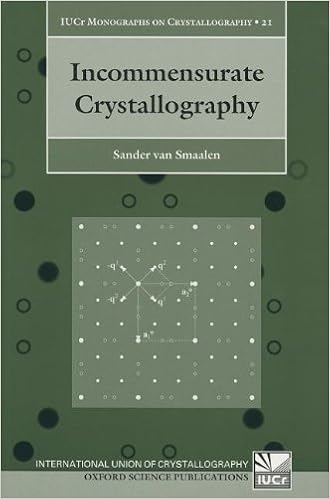
Download e-book for iPad: Incommensurate Crystallography by Sander van Smaalen
The crystallography of aperiodic crystals employs many ideas which are frequently utilized to periodic crystals. the current textual content has been written less than the idea that the reader understands innovations like house crew symmetry, Bragg reflections and vector calculus. This assumption is stimulated by way of the popularity that readers attracted to aperiodic crystals will frequently have a historical past within the stable country sciences, and through the truth that many books can be found that take care of the crystallography of tronslational symmetric constructions at either introductory and complex degrees.
New PDF release: Powder Diffraction: Theory and Practice
''This publication offers a great evaluate and masses element of the state-of the-art in powder diffraction tools. '' (Chemistry global. 2008. 5(11), p. p. sixty three) This ebook offers a huge evaluation of, and advent to, cutting-edge equipment and functions of powder diffraction in study and undefined.
Crystal Growth: Principles and Progress by A.W. Vere PDF
This publication is the second one in a chain of medical textbooks designed to hide advances in chosen study fields from a uncomplicated and common standpoint, in order that basically restricted wisdom is needed to appreciate the importance of contemporary advancements. extra suggestions for the non-specialist is supplied by way of the precis of abstracts partly 2, together with some of the significant papers released within the learn box.
- Crystal Structure Analysis for Chemists and Biologists
- Classical Tessellations and Three-Manifolds
- Macromolecular physics - Crystal nucleation, growth, annealing
- Aromatic Heterocyclic Chemistry
Additional resources for Inorganic Photochemistry
Sample text
30 MORGAN L. CABLE et al. III. Additional Factors That Govern Complex Stability A. STERIC EFFECTS Initially, ancillary ligands were envisioned as a way to impart steric selectivity for a particular analyte of interest. By leaving only two adjacent coordination sites available on the lanthanide, for instance, it could be assumed that only bidentate ligands would bind to the metal center and that tri- or tetradentate ligands would be excluded from the lanthanide coordination sphere. This design could be further extended by modification of the ancillary ligand to generate a highly specific receptor site, with hydrophobic or hydrophilic regions that would be complementary only to the target analyte.
The proposed technology could improve the current LOD by several orders of magnitude. We are currently working to modify the DO2A ligand to append to solid substrates. Recent results indicate a negligible change in binding affinity when one of the acetate moieties is exchanged for an amide group with similar resilience to pH variations (172). V. Conclusions We have summarized the common attributes of ancillary ligands in improving detection techniques based on sensitized lanthanide luminescence and also introduced a new model for enhanced binding affinity.
D. SELECTIVITY Ancillary ligands also impart selectivity to lanthanide-based detection strategies, improving resistance to common environmental interferents. For lanthanides, which rely on ionic interactions for analyte binding, the greatest threat is from charged species. Anions, particularly those containing oxygen donors or otherwise have the ability to complex metal ions, could compete with the target analyte for the lanthanide and produce a false negative result. If these anionic interferents are aromatic and capable of transferring energy to the lanthanide, we might also encounter false positives.
Inorganic Photochemistry by Rudi van Eldik and Grażyna Stochel (Eds.)
by James
4.4