
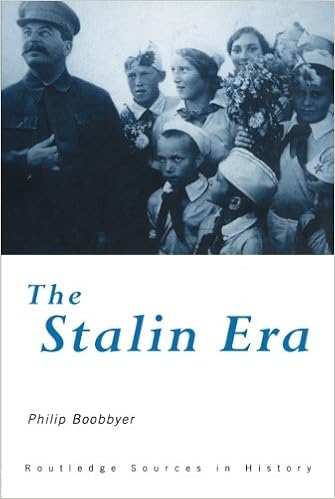
By Philip Boobbyer
ISBN-10: 0415182980
ISBN-13: 9780415182980
This booklet presents a wide-ranging historical past of each element of Stalin's dictatorship over the peoples of the Soviet Union. Drawing upon an enormous array of basic and secondary assets, The Stalin Era is a first-hand account of Stalinist idea, coverage and and their results. It areas the guy and his ideology into context either inside pre-Revolutionary Russia, Lenin's Soviet Union and post-Stalinist Russia. The Stalin Era examines:
* collectivisation
* industrialisation
* terror
* government
* the Cult of Stalin
* schooling and Science
* family
* faith: The Russian Orthodox Church
* paintings and the country.
Read or Download The Stalin Era (Routledge Sources in History) PDF
Best russia books

Read e-book online The Great French Revolution 1789-1793 Volume 2 PDF
Kropotkin's moment quantity keeps his interpretation of this old occasion via targeting the conflict among the Jacobins and their competitors - the Hebertistes, Enrages and Anarchists. during this conflict among authoritarians and anti-authoritarians, Kropotkin attracts out the origins of Marxism and Leninism in the Jacobins.
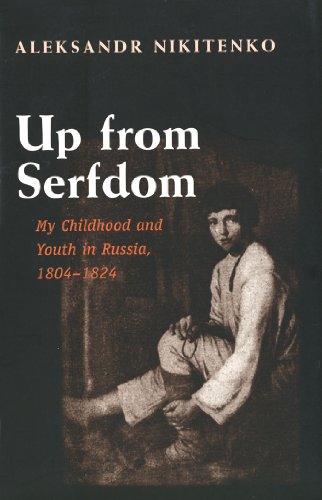
Up from Serfdom: My Childhood and Youth in Russia, 1804-1824 - download pdf or read online
Aleksandr Nikitenko, descended from once-free Cossacks, used to be born into serfdom in provincial Russia in 1804. certainly one of 300,000 serfs owned by means of count number Sheremetev, Nikitenko as grew to become fiercely made up our minds to realize his freedom. during this memorable and relocating publication, the following translated into English for the 1st time, Nikitenko recalls the main points of his adolescence and formative years in servitude in addition to the six-year fight that finally brought him into freedom in 1824.
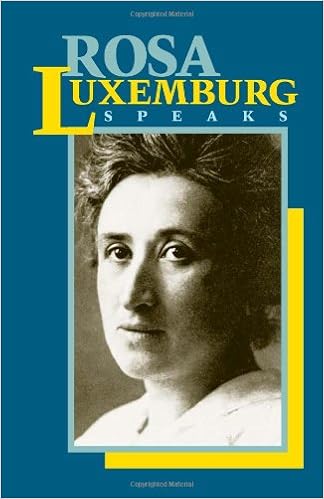
Rosa Luxemburg's Rosa Luxemburg Speaks PDF
Simply weeks earlier than her homicide, Rosa Luxemburg informed her comrades:
"Today we will heavily set approximately destroying capitalism once
and for all.
"Nay, extra; no longer in basic terms are we this day able to practice this
task, no longer in basic terms is its functionality an obligation towards the proletariat, but
our answer deals the single technique of saving human society from destruction. "
Such was once the conviction that guided her life.
To a global simply rising from the holocaust of the 1st global War
her phrases had a pointy immediacy. Fifty years and several other devastating
wars later, the choice she poses - socialism or extermination -
still is still the alternative dealing with humanity.
- From the advent by means of Mary-Alice Waters

Read e-book online Historians as Nation-Builders: Central and South-East Europe PDF
A variety of papers from a convention held in honour of Professor Hugh Seton-Watson at the get together of his retirement in l983. the purpose of the participants is to demonstrate the function of the historian within the political lifetime of primary and East ecu countries.
- My Russian Family
- Lavochkins Last Jet
- Tales of Imperial Russia: The Life and Times of Sergei Witte, 1849-1915
- Russia at the Barricades: Eyewitness Accounts of the August 1991 Coup
- The New Cold War: Putin's Russia and the Threat to the West
- One Day in the Life of Ivan Denisovich
Additional resources for The Stalin Era (Routledge Sources in History)
Sample text
8 Declaration of the Thirteen Lenin always took into account the danger that the concentration of administrative power in the hands of the party would lead to bureaucratic pressure on the Party. Precisely from this arose Vladimir Ilich’s idea about organizing the Control Commission, which, while it had no administrative power in its hands, would have all the power essential for the struggle with bureaucratism, for the defense of the right of a party member to express his 21 22 From Lenin to Stalin convictions freely and to vote according to his conscience without fearing any punitive consequences .
8–9. The nature of resistance strategies is also a central issue in Stephen Kotkin’s recent, acclaimed study of Magnitogorsk in the 1930s, Magnetic Mountain (1995). Kotkin is interested in what French philosopher Michel Foucault called the problem of ‘subjectivity’: the processes by which individuals are made. Kotkin argues that the struggle between state and society in the 1930s resulted in a new Bolshevik culture; Stalinism is best understood as a system embracing new social and cultural patterns Interpreting the Stalin era of behaviour.
4 January 1923. Stalin is too crude, and this defect, although quite tolerable in our midst and in dealings with us Communists, becomes intolerable in a general secretary. That is why I suggest that the comrades think about a way of removing Stalin from that post and appointing another man in his stead who in all other respects differs from Comrade Stalin in having only one advantage, namely in being more tolerant, more loyal, more polite, and more considerate to the comrades, less capricious, etc.
The Stalin Era (Routledge Sources in History) by Philip Boobbyer
by Donald
4.0