
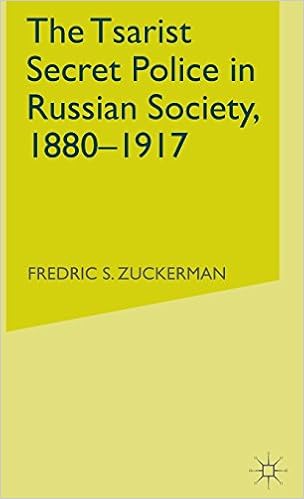
By Frederic S Zuckerman, F Zuckerman
ISBN-10: 0333633962
ISBN-13: 9780333633960
This article portrays the heritage of the Russian mystery police - the so-called Okhrana - it group of workers, global view and interplay with either govt and other people throughout the reigns of Alexander III and Nicholas II. the key police pressured, infiltrated and subverted Russian radical and revolutionary society because it struggled to maintain Tsardom's conventional political tradition within the face of Russia's quick socio-economic transformation - a metamorphosis which the forces of order scarcely understood, but deeply despised.
Read Online or Download The Tsarist Secret Police in Russian Society, 1880-1917 PDF
Best russia books

Read e-book online The Great French Revolution 1789-1793 Volume 2 PDF
Kropotkin's moment quantity keeps his interpretation of this historical occasion through focusing on the conflict among the Jacobins and their rivals - the Hebertistes, Enrages and Anarchists. during this conflict among authoritarians and anti-authoritarians, Kropotkin attracts out the origins of Marxism and Leninism in the Jacobins.
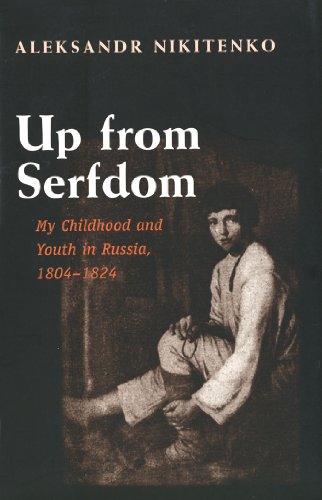
New PDF release: Up from Serfdom: My Childhood and Youth in Russia, 1804-1824
Aleksandr Nikitenko, descended from once-free Cossacks, was once born into serfdom in provincial Russia in 1804. one in all 300,000 serfs owned through count number Sheremetev, Nikitenko as turned fiercely decided to achieve his freedom. during this memorable and relocating e-book, right here translated into English for the 1st time, Nikitenko recalls the main points of his adolescence and formative years in servitude in addition to the six-year fight that eventually introduced him into freedom in 1824.
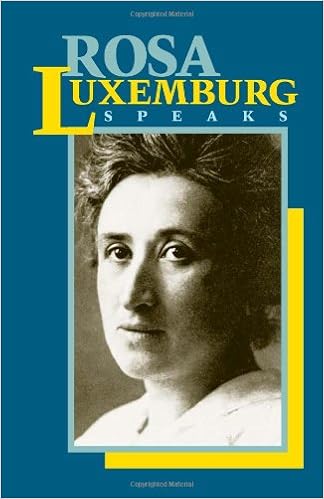
Simply weeks prior to her homicide, Rosa Luxemburg advised her comrades:
"Today we will be able to heavily set approximately destroying capitalism once
and for all.
"Nay, extra; now not in simple terms are we this present day capable of practice this
task, now not simply is its functionality an obligation towards the proletariat, but
our answer deals the single technique of saving human society from destruction. "
Such was once the conviction that guided her life.
To a global simply rising from the holocaust of the 1st international War
her phrases had a pointy immediacy. Fifty years and several other devastating
wars later, the choice she poses - socialism or extermination -
still continues to be the alternative dealing with humanity.
- From the advent by way of Mary-Alice Waters

A range of papers from a convention held in honour of Professor Hugh Seton-Watson at the celebration of his retirement in l983. the purpose of the individuals is to demonstrate the function of the historian within the political lifetime of crucial and East ecu countries.
- National Identity in Russian Culture: An Introduction
- The Sociology of the Soviet Union: Psychology in the Soviet Union
- A Revolution of the Spirit: Crisis of Value in Russia, 1890-1924
- Stalin. Eine Biographie
- Rewriting the Jew : Assimilation Narratives in the Russian Empire
- Stalin and the Soviet Union (Questions and Analysis in History)
Extra info for The Tsarist Secret Police in Russian Society, 1880-1917
Sample text
The Ministry of Internal Affairs (commonly and herein often identified by its Russian initials MVD) itself expressed, to no avail, its disapproval of the growing political police habit of riding roughshod over the population at large. 17 Political police officials became so contemptuous of the instructions they received from St Petersburg that they went so far as to employ the Exceptional Measures in non-political cases. 18 The overheated police environment created by the decrees of the 1870s and the Emergency Statute of 1881 had had their effect.
This final addition to the number of secretariats coordinated police interests in the districts occupied by the army. The duties of these secretariats remained flexible with the MVD ordering them to take on additional assignments as the situation demanded. 24 This complex of bureaus resided in Department of Police headquarters, a building situated among a row of homes and offices on quiet tree-lined Fontanka Quai with the slow flowing Fontanka River moving past its windows where soon the Department of Police and the building in which it was located became so identified with each other that the forces of order commonly referred to the Department by the nickname of 'Fontanka'.
One of von Koten's primary functions was to teach the recruits to identify their subjects in exceptional detail using precise language. The very choice of words used to describe a subject was considered vital. For instance, hair colouring was to be described as brunette, brownhaired (shaten), blonde, redhead (ryzhii) and grey. Less easily visualised words such as chestnut (kashtanovii), or combinations of words such as dark-redhead (temno-ryzhii) and light-redhead (svetlo-ryzhii) were not to be employed.
The Tsarist Secret Police in Russian Society, 1880-1917 by Frederic S Zuckerman, F Zuckerman
by Thomas
4.2